
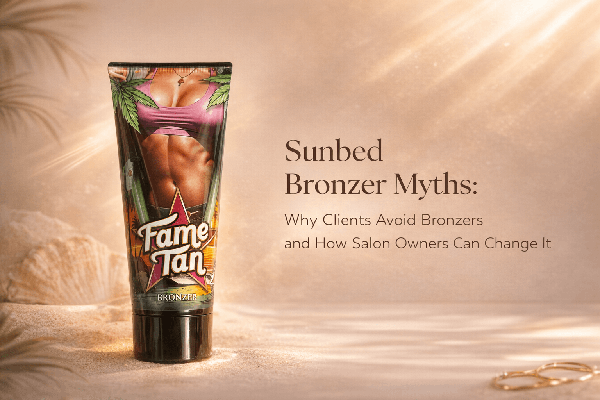
Sunbed Bronzer Myths: Why Clients Avoid Bronzers and How Salon Owners Can Change It
For many tanning salon owners, bronzers have become one of the most misunderstood product categories on the shelf. Over the years, their popularity has declined in many salons, not because they stopped working, but because clients stopped understanding what they actually do.
When we speak to salon owners across the UK, the same pattern keeps appearing. Clients associate bronzers with fake tan, staining, or unnatural results. As a result, they avoid them altogether. In many cases, salons quietly move bronzers aside rather than addressing the real issue behind the resistance.
The truth is simple. Bronzers did not fail. Education did.
This article is written for salon owners who want to understand why bronzers lost favour and how proper explanation can turn them back into a valuable, profitable tool.
Why bronzers lost popularity in tanning salons
Bronzers started disappearing from salons not because of performance, but because of confusion. When clients are not clearly told how a product works, they fill in the gaps themselves. Usually with assumptions based on self tan, past experiences, or misinformation.
Over time, that confusion creates resistance. Staff stop recommending bronzers to avoid awkward conversations. Clients stop asking about them. Eventually, a product category quietly fades out, even though it still delivers strong results when used correctly.
Myth 1: Bronzer is the same as fake tan
This is the most common misunderstanding and the most damaging one.
A professional sunbed bronzer is not a self tan. It does not work on its own and it does not replace UV exposure. Indoor tanning bronzers are designed to work alongside UV, supporting colour development and enhancing the visible result of a session.
UV exposure is still doing the real tanning work. The bronzer simply helps the client see colour sooner, evens out tone, and improves overall satisfaction, especially for clients who tan more slowly.
Once this is explained clearly, many clients immediately rethink their position.
Myth 2: All bronzers are very dark
Many clients hear the word “bronzer” and imagine instant deep brown colour or an orange finish. In reality, bronzers come in a wide range of formulations.
Modern professional bronzers can be extremely subtle. Some are almost clear and designed purely to enhance tone without obvious cosmetic colour. Others are stronger and intentionally deliver a faster, deeper visual result.
This distinction matters. At Fame Tan, for example, lighter bronzers are formulated to absorb quickly and avoid transfer onto clothing or bedding. Strong bronzers, on the other hand, are created for experienced clients who want immediate impact and understand what they are using.
The key point is this. Darkness depends on formulation, not on the word “bronzer” itself.
Myth 3: Bronzers always stain clothes and bedding
This fear stops many clients before they even consider trying a bronzer.
The reality is more balanced. Not all bronzers behave the same way. Many modern professional formulas are designed to minimise transfer and absorb quickly when used correctly. When salons provide proper aftercare advice, staining becomes far less of an issue than clients expect.
However, honesty is crucial. Strong bronzers can transfer more. Pretending otherwise damages trust. When clients are told clearly what to expect, they can make an informed decision and are far more likely to be satisfied with the result.
Clear communication always beats overselling.
Myth 4: Bronzers give fake looking results
Another misconception is that bronzers somehow cancel out “real” tanning. In fact, the opposite is true.
UV exposure continues to stimulate natural tanning processes. The bronzer simply enhances the visible outcome. It helps even out skin tone, supports areas that develop more slowly, and gives clients a confidence boost after their session.
For clients who struggle to see colour quickly, bronzers can make the difference between disappointment and motivation to continue tanning responsibly.
How Fame Tan approaches bronzer formulation
The approach behind modern bronzers is not about tricking the eye. It is about supporting the client journey.
Fame Tan bronzers are developed with clear intent. Some formulas focus on clean application, fast absorption, and minimal transfer, making them ideal for cautious or first time bronzer users. Strong bronzers are designed for clients who actively want faster, more dramatic visual results and understand how to use them properly.
This clear separation allows salon staff to recommend products confidently, without confusion or mixed messages.
How salon staff should explain bronzers to clients
The difference between resistance and acceptance often comes down to a single conversation.
Avoid technical language. Clients do not need chemistry. They need clarity.
Make it clear that UV exposure is still responsible for the tanning process. Position bronzer as a product that enhances and supports the colour that is already developing. Clearly outline the difference between subtle formulas and strong bronzers, and set realistic expectations about what the client will see after their session.
When expectations are managed properly, bronzers stop being risky and start becoming reliable.
The real value of bronzers in a modern tanning salon
Bronzers are not for everyone. Just like tingle products, they suit specific clients at specific stages. But when matched correctly, they deliver three key benefits.
Clients feel more satisfied with their session. Product sales increase naturally without pressure. Trust grows because the salon positions itself as an educator, not just a retailer.
The product itself has not changed. The explanation has.
Need support choosing the right bronzers for your salon?
If you want guidance on selecting bronzers, training staff, or matching products to the right clients, speak to a specialist at Best Sunbeds.
Oliwia
General: +44 1865 718485
Cosmetics: +44 7928 235519
Email: cosmetics@bestsunbeds.co.uk
The right product works best when it is explained properly.